
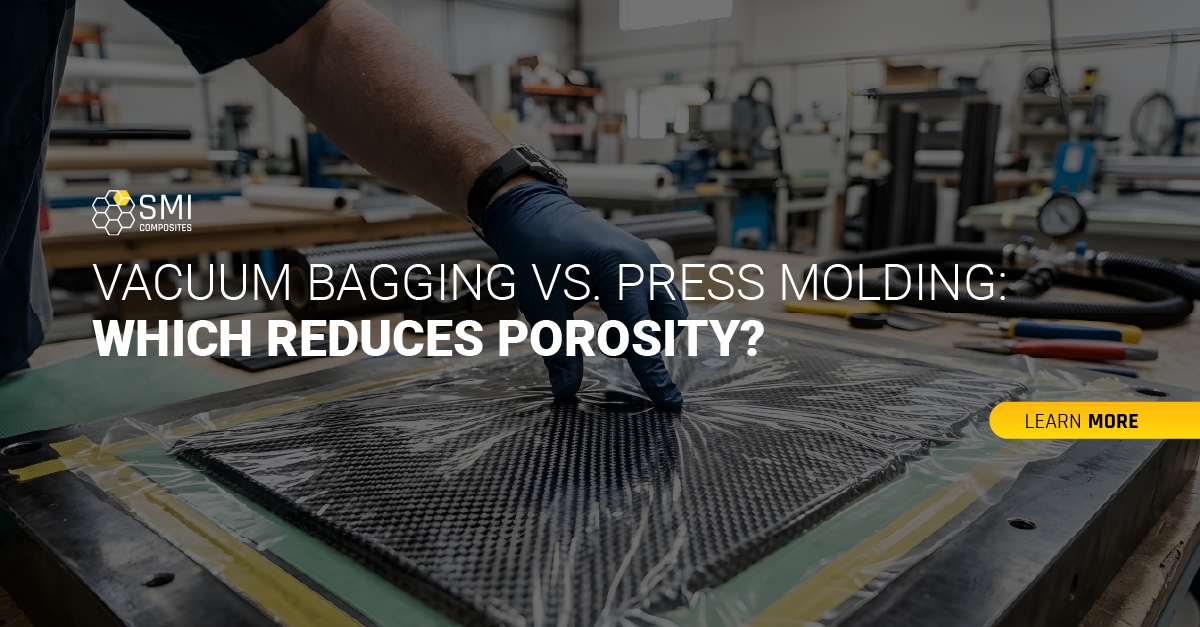
Press molding can provide stronger mechanical consolidation than out-of-autoclave vacuum bagging, helping control void content and porosity. Vacuum bagging, on the other hand, conforms more easily to complex part geometries, including curves, thin sections, and detailed features. When it comes to consolidation pressure and resin flow, press molding can apply higher pressure.
Vacuum bagging relies on controlled vacuum and resin behavior in high-performance composites. Mordor Intelligence projects that the composite material market will grow from $70.94 billion in 2026 to $89.93 billion by 2031.
Your company may be part of the manufacturers driving that growth. Knowing when to use out-of-autoclave processing or press molding can help you produce reliable parts with lower porosity.
How Do Environmental Conditions Affect Resin Curing During Part Fabrication?
Resin curing during part fabrication can change based on:
- Temperature
- Humidity
- Airflow
- Resin viscosity
- Fiber moisture content
Higher heat can lower resin viscosity, helping it flow around fibers. Excess moisture can interfere with curing and increase the chance of trapped gases. A controlled workshop environment can support more consistent resin flow and cure results.
Vacuum Bagging vs. Press Molding High-Performance Composites
Weighing various manufacturing methods can help you match the process to your part design and production needs. Specialists like SMI Composites can assess material behavior, tooling requirements, and cure conditions before fabrication. Our team can help you select a process that supports your project’s geometry, quality targets, and production volume.
Void Content and Porosity Control
Air trapped in a laminate can create voids that affect strength and surface quality. A void content comparison can show how vacuum bagging and press molding perform with your materials and cure cycle.
Press molding can apply greater pressure to improve consolidation. Vacuum bagging can achieve low porosity with a tight seal and adequate resin flow. Controlled temperature, resin degassing, and careful layup can reduce trapped air.
Handling Complex Part Geometries
Complex shapes need a process that follows:
- Curves
- Corners
- Changing thickness
- Tight radii
- Thin sections
Complex geometry manufacturing can favor vacuum bagging because the flexible bag adapts to the tool surface. It can reach areas a rigid press mold may compress unevenly. Press molding suits simpler parts with consistent wall thickness.
Consolidation Pressure and Resin Flow
Pressure affects how tightly fibers pack together and how well resin fills the spaces between them. Out-of-autoclave processing uses vacuum and atmospheric pressure to consolidate the laminate without an autoclave. Vacuum bag resin infusion can pull resin through the fiber bed and remove air before cure.
Press molding can supply higher pressure, which may improve fiber packing in suitable geometries. Resin viscosity, injection rate, and tool temperature can influence whether resin reaches every region of the part.
Outsource High-Performance Composites Manufacturing to SMI
Your part geometry, production volume, and strength requirements determine the ideal manufacturing method. Vacuum bagging suits curved, thin, and complex parts, while press molding delivers greater pressure and more consistent thickness. Both produce strong, low-porosity, high-performance composites with proper resin flow, tooling, and curing.
At SMI, we help you select the right process for your composite part. Since 2014, we have built more than a decade of experience in composite design, tooling, and manufacturing. We offer out-of-autoclave curing, compression molding, and custom tooling.
We support both low-volume and high-volume production. Partner with us to manufacture reliable high-performance composites for your project.
