
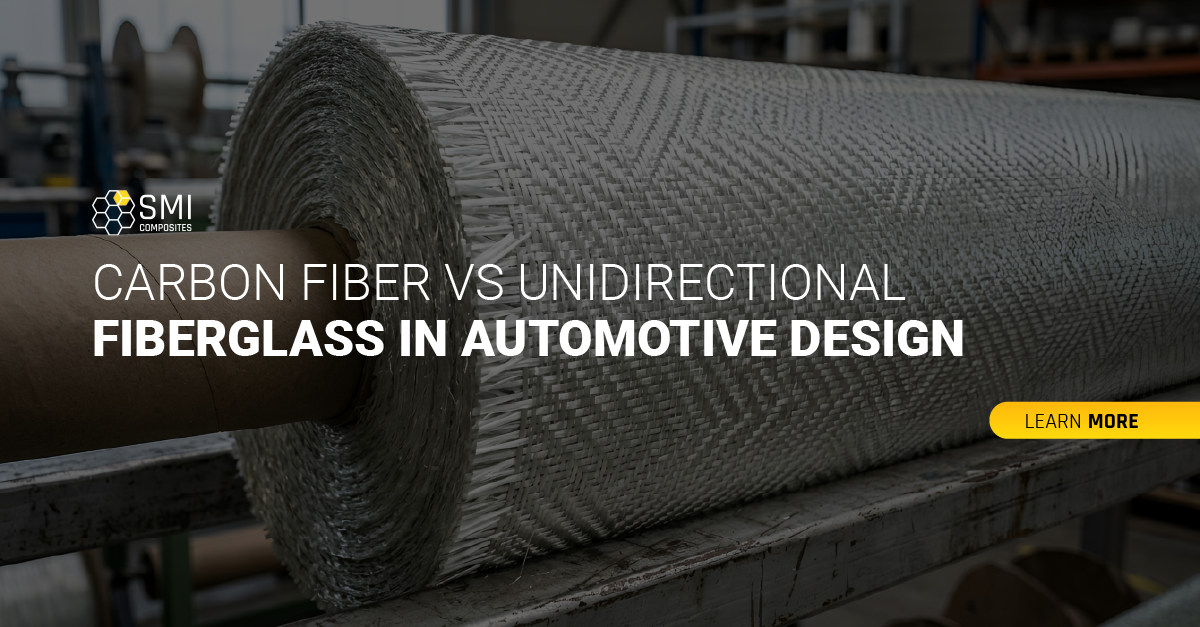
Carbon fiber offers the highest stiffness-to-weight ratio, ideal when rigidity and mass reduction matter most. Unidirectional fiberglass costs less and handles impact better, making it the stronger choice for budget-conscious or crash-absorbing parts. A carbon-fiberglass hybrid often captures the best of both, placing carbon along load paths and glass where cost or impact tolerance matter more.
The U.S. Department of Energy reports that carbon fiber-reinforced composites could deliver a 50-75% weight reduction for certain components. That reduction changes how your part performs, not just what it costs. The real question isn’t which material is better, but which fits your load case, budget, and production volume.
What Makes Unidirectional Fiberglass Effective for Automotive Reinforcement?
Unidirectional fiberglass performs best when loads follow a predictable direction. Its continuous fibers concentrate strength where stress is highest. Proper reinforcement requires:
- Fiber orientation aligned with the load path
- Laminate thickness suited to the primary load
- Cross-plies for transverse or shear loads
Without these considerations, the fiberglass may not perform as intended. Fiber orientation is a key design decision, not simply a material specification.
When a Carbon Fiberglass Hybrid Makes More Sense
A carbon-fiberglass hybrid makes sense when stiffness demands vary across a part. Full carbon may waste material on low-stress areas. The right layup starts with mapping the part and identifying:
- Load transfer concentration points
- Regions tolerant of added flex
- Stacking sequence at the material interface
Misjudging these factors can erase the hybrid’s cost benefits or leave high-stress areas underbuilt. At SMI Composites, we map stiffness requirements first to place fibers where the part needs them most.
How to Compare Cost With Structural Performance
The cheapest fiber isn’t always the cheapest part. Raw material price ignores everything else that goes into a finished laminate. A proper material selection matrix looks past sticker price to:
- Labor and tooling requirements
- Total laminate volume needed
- Part weight versus downstream performance
A pricier carbon laminate often wins once it cuts enough material or weight to offset the premium. Fiberglass wins instead when that extra weight barely affects the part’s function, making it the stronger fit for cost-effective structural parts where performance gains don’t justify carbon’s premium.
Reinforcement Strategy That Fits Different Automotive Parts
Matching material to part starts with what the part actually needs to survive. It shouldn’t default to a preference for carbon or glass. Three part categories illustrate this clearly:
- Predictable, single-direction loads
- Mixed stiffness demands across one part
- Mass-critical, uniformly stiff parts
Fiberglass suits the first, a hybrid layup the second, and full carbon the third. Let the part’s function decide the material, not the other way around.
Find the Right Composite Reinforcement for Your Automotive Part
Unidirectional fiberglass, carbon fiber, and hybrid layups each suit different applications. The right choice depends on load path, budget, and volume, with performance following the right material match.
At SMI Composites, we bring decades of composite manufacturing expertise to automotive, aerospace, defense, medical, and sports industries. As part of the Mayco Group of companies, we offer complete solutions from design and engineering to custom tooling.
Our capabilities span autoclave curing, compression molding, and bladder molding for both low and high-volume projects. Contact us today to select the right reinforcement strategy for your part’s performance and volume.
